
There is something undeniably magical about transforming humble ingredients—usually just flour and eggs—into a magnificent, golden mound of fresh pasta. The texture, the rich flavor, and the sheer satisfaction of creating your own noodles from scratch elevate a simple dinner into a culinary event. However, if you have ever tried to roll out a sheet of dough with a makeshift rolling pin or cut thin strands of spaghetti with a dull kitchen knife, you know that the process can quickly become frustrating without the right equipment.
To achieve restaurant-quality results, investing in the right equipment is paramount. Utilizing the proper tools for homemade pasta not only saves time and reduces physical strain, but it also ensures the structural integrity and uniform thickness required for even cooking.
Whether you are a novice looking to embark on your first culinary adventure or an experienced home cook seeking to refine your technique, having a dedicated toolkit will completely transform your workflow. Below, we break down the 7 essential tools for homemade pasta that will help you achieve pasta perfection every single time.
Essential Tools for Homemade Pasta at a Glance
Making fresh pasta at home is much easier when you have the right equipment. While some tools for homemade pasta are essential for consistent results, others can help speed up preparation and improve the final texture of your pasta.
The table below compares the most useful cooking gear and highlights its primary benefits.
Choosing the right tools for homemade pasta depends entirely on your experience level, budget, and the types of shapes you plan to make.
| Tool | Best For | Key Benefits | Difficulty Level | Recommended Product |
| Pasta Maker | Rolling and cutting pasta dough | Consistent thickness, faster preparation | Beginner | Marcato Atlas 150 |
| Pasta Drying Rack | Drying fresh pasta | Prevents sticking and improves drying | Beginner | Collapsible Pasta Drying Rack |
| Digital Kitchen Scale | Accurate ingredient measurement | Better dough consistency | Beginner | Digital Food Scale |
| Bench Scraper | Handling and cutting dough | Cleaner workspace and easier dough management | Beginner | Stainless Steel Bench Scraper |
| Ravioli Stamp | Making filled pasta | Creates uniform ravioli quickly | Intermediate | Ravioli Stamp Set |
| Wooden Rolling Pin | Rolling dough manually | Traditional pasta-making method | Beginner | Hardwood Rolling Pin |
| Dough Cutter Wheel | Decorative pasta cutting | Precise cutting and decorative edges | Intermediate | Stainless Steel Pasta Cutter |
Marcato Atlas 150 pasta maker
The Science of the Wood Surface
Unfinished or lightly oiled wood possesses a natural, microscopic texture that provides the perfect amount of “grip” for the dough. This friction is essential when you are kneading or rolling out dough with a rolling pin, as it prevents the dough from snapping back continuously. Furthermore, wood absorbs excess moisture from the dough far better than non-porous surfaces, preventing stickiness without requiring you to dump excessive amounts of flour onto your board—making a wooden board one of the most practical tools for homemade pasta.
Key Features to Look For
The Lip or Cleat: A proper Italian pastaboard features a wooden lip on the underside that hooks over the edge of your counter. This brilliant design element keeps the board perfectly stable, preventing it from sliding around while you exert heavy force during kneading.
Size Matters: Look for a board that is at least 24x36 inches. You need ample space to stretch out long sheets of dough, pile your flour wells, and arrange your cut pasta shapes before they head to the pot. When organizing your essential tools for homemade pasta, prioritizing a board with these generous dimensions will save you a lot of frustration1. The Pasta Machine (Roller and Cutter)
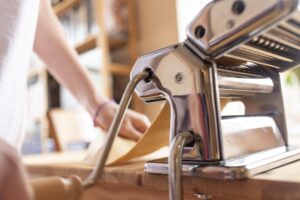
When it comes to building your artisanal kitchen setup, a reliable pasta machine is the undisputed crown jewel of tools for homemade pasta. While rolling dough by hand is a romantic notion, achieving the paper-thin, uniform consistency needed for delicate fettuccine or stuffed ravioli is incredibly difficult without mechanical assistance.
               [ Manual Crank ]
                      │
[ Smooth Rollers ] ───┼─── [ Thickness Adjustment Dial ]
                      │
               [ Cutter Attachments (Spaghetti/Fettuccine) ]
Manual vs. Electric Machines
You generally have two choices: a traditional manual crank machine or an electric model (or motorized attachment).
Classic hand-crank models, like the iconic Italian-made Marcato Atlas 150, are beloved by purists and home chefs alike. These time-tested devices offer precise tactile feedback, allowing you to intuitively feel the exact resistance of the dough as it passes through the specialized anodized aluminum rollers. Because they are exceptionally durable, require no electrical outlets, and give you total control over the rolling speed, they remain the ultimate foundational centerpiece for anyone building a collection of premium tools for homemade pasta.
Manual Machines: Classic hand-crank models, like the iconic Italian-made Marcato Atlas 150, are beloved by purists. They offer precise tactile feedback, allowing you to feel the resistance of the dough as it passes through the rollers. They are highly durable, require no electrical outlets, and give you complete control over the speed of the rolling process.
Electric Machines & Attachments: If you own a stand mixer, investing in a motorized roller attachment is a game-changer. The primary advantage here is hands-free operation. With both hands free to guide the delicate sheet of dough as it exits the machine, you drastically reduce the risk of tearing or folding.
Why It Is Essential
A pasta machine allows you to gradually graduate from the thickest setting down to the thinnest sheets without overworking the gluten. This gradual reduction is critical; if you try to force the dough to thin out too quickly, it will snap or develop holes. For uniform cooking and a sublime mouthfeel, a dedicated machine is the most vital of all tools for homemade pasta.
2. A Large Wooden Pastaboard (Spianatoia)
Many beginners underestimate the importance of the surface they work on. Rolling, kneading, and shaping dough directly on granite, quartz, or stainless steel countertops can introduce unwanted temperature variables. Cold stone countertops can chill the dough, making the gluten stubborn and difficult to stretch. This is why a traditional wooden pastaboard, known in Italy as a spianatoia, is one of the most underrated tools for homemade pasta.
3. The Mattarello (Traditional Italian Rolling Pin)
Even if you own an electric pasta machine, a traditional Italian rolling pin, called a mattarello, belongs in your arsenal of essential tools for homemade pasta. Unlike standard American or French rolling pins, which are relatively short and often feature rotating handles or tapered ends, a mattarello is a long, heavy, straight wooden dowel—often measuring between 30 to 40 inches in length.
┌────────────────────────────────────────────────────────────────────────┐
│                               Mattarello                               │
└────────────────────────────────────────────────────────────────────────┘
 ◄────────────────────────────── 30 to 40 inches ───────────────────────►
The Art of Sfoglia
In the Emilia-Romagna region of Italy, master pasta makers (sfogline) roll out massive sheets of dough using only a mattarello. When mastering the traditional tools for homemade pasta, the immense length of this rolling pin allows you to roll across a massive surface area simultaneously, ensuring that the entire sheet (the sfoglia) maintains an identical thickness throughout.
Why You Need On
A mattarello is uniquely suited for preparing hand-rolled styles like tagliatelle, pappardelle, or maltagliati. Rolling by hand stretches the gluten strands differently than the compression of machine rollers, resulting in a unique, slightly porous texture that clings to heavy ragùs and sauces beautifully. Learning to use a mattarello takes patience, but it connects you deeply to the centuries-old craft of hand-formed pasta, making it one of the most rewarding tools for homemade pasta you can master.
In pastry making, precision is law—and the same rule applies to the world of fresh pasta. Relying on volumetric measurements (like cups and tablespoons) is one of the quickest ways to ruin a batch of dough. A cup of flour can vary drastically in weight depending on how tightly packed it is, the ambient humidity, and how it was sifted. Therefore, a precise digital kitchen scale is one of your most non-negotiable tools for homemade pasta.
The Perfect Ratio
Classic Italian pasta dough often relies on specific baker’s percentages or strict weight ratios, such as the classic standard: 100g of flour to 1 whole egg (approx. 50-60g). When working with these delicate ratios, a digital kitchen scale becomes one of your most non-negotiable tools for homemade pasta. If your flour is too heavy or your eggs are on the smaller side, your dough will turn out crumbly, dry, and impossible to roll. Conversely, too much moisture yields a sticky mess that gums up your machine rollers.
Choosing the Right Scale
Look for a digital scale that offers:
Tare functionality to zero out the weight of your bowls.
Measurement increments down to 0.1 grams for precision.
A clear, backlit display that won’t be obscured by large mixing bowls.
By measuring your ingredients in grams, you remove all guesswork from the equation, guaranteeing repeatable success every time you gather your tools for homemade pasta.
5. Fluted Pastry Wheel (Ravioli Cutter)
Once you have successfully rolled out beautiful, thin sheets of dough, you need a way to slice them into gorgeous shapes. While a sharp chef’s knife works well for straight cuts like tagliolini, a fluted pastry wheel introduces beautiful geometry and functionality to your kitchen. It is an indispensable item among shaping tools for homemade pasta.
    ( )   <- Fluted, zigzag cutting wheel
     │
   ──┴──  <- Sturdy metal frame
     │
    [ ]   <- Ergonomic wooden/metal handle
Aesthetics and Functionality
The fluted wheel features a sharp, zigzagging metal disk that creates a classic pinked edge on your dough. This isn’t just for visual flair; when building your collection of tools for homemade pasta, this cutter serves a vital structural purpose. When making stuffed shapes like ravioli, tortelli, or agnolotti, the ridged edge created by a fluted cutter actually helps to lock and seal the top and bottom sheets of dough together, trapping the filling securely inside.
Versatility in Shapes
Beyond ravioli, a fluted cutter is fantastic for making:
Farfalle (Bowties): Cut rectangles with fluted ends, then pinch them in the middle.
Lasagna Sheets: Give your baked lasagna dishes an elegant, wavy edge along the sides.
Garganelli Strips: Pre-cutting perfect squares before rolling them over a ridged board.
Investing in a high-quality brass or stainless steel wheel ensures clean cuts through the dough without dragging or tearing your delicate sheets.
6. Gnocchi Board and Garganelli Ridger
Texture is just as important as flavor when it comes to pasta. The ridges on the exterior of certain shapes aren’t random design choices—they are specifically engineered to hold onto pasta sauce via capillary action. To create these beautiful textures by hand, a wooden gnocchi board (and its companion, the garganelli pin) is a vital asset to your collection of tools for homemade pasta.
How It Works
A gnocchi board is a small, handheld wooden paddle featuring distinct, parallel ridges cut into its surface. To use it, you take a small nugget of dough, press it against the board with your thumb, and roll it downward with a flick of your wrist. This single motion accomplishes two critical things:
It imprints deep ridges on the outside of the pasta.
It creates a subtle curl or hollow pocket on the underside.
This hollow cavity acts as a reservoir for your sauce, ensuring that every single bite delivers an explosion of flavor. Because it is inexpensive, compact, and incredibly easy to use, this handy gadget is a fantastic addition to your collection of tools for homemade pasta. In fact, it remains one of the most accessible and rewarding tools for homemade pasta available today.
7. Wooden Pasta Drying Rack (Stendino)
Congratulations! You’ve mixed, kneaded, rolled, and cut your dough into gorgeous, uniform strands of fettuccine. But what do you do with them while you wait for your massive pot of salted water to come to a rolling boil? If you pile them up on a plate or countertop, they will inevitably stick together into a gummy mass due to residual moisture. This is why a wooden drying rack, or stendino, is the final piece of the puzzle for your essential tools for homemade pasta.
      ──┬── Top Hub
     ┌─┼─┐
    /  │  \
   /   │   \  <- Extending wooden dowels to hang strands
Air Circulation is Key
A drying rack elevates your freshly cut noodles off the counter, allowing dry air to circulate completely around each strand. This dries out the very exterior surface of the dough just enough to eliminate stickiness, a process known as “skinning over.”
Storage and Convenience
Most premium drying racks feature a spiral or clothesline design with removable wooden wands. When evaluating your essential tools for homemade pasta, this feature is incredibly practical; you can hold a wand directly underneath your pasta machine’s cutting head to catch the strands as they fall, then instantly transfer the wand straight to the rack frame without ever touching the dough directly with your hands.
Furthermore, if you intend to preserve your pasta for future meals, a drying rack allows you to dry your noodles completely solid over 24 hours so they can be safely stored in airtight containers. For preserving the shape and integrity of your hard work, don’t overlook this crucial addition to your tools for homemade pasta.
Summary Checklist of Essential Pasta Tools
To help you audit your current kitchen inventory, here is a quick summary table of the seven vital tools for homemade pasta discussed in this guide:
Beyond the Tools: Tips for Homemade Pasta Success
Acquiring the ultimate assortment of tools for homemade pasta is a massive step forward, but mastering the technique requires understanding how these pieces of equipment interact with your ingredients. Here are a few foundational principles to keep in mind as you put your new gear to work:
Respect the Rest Period
After you have mixed and kneaded your dough on your wooden pastaboard, it will likely feel tense and springy. This is because the gluten network has been highly stimulated. Never attempt to run unrested dough through your pasta machine, as it is one of the most common mistakes when working with tools for homemade pasta. Wrap the dough tightly in plastic wrap and let it rest at room temperature for at least 30 minutes. During this time, the gluten relaxes and the flour hydrates completely. When you return to rolling it out, the dough will be beautifully compliant, silky, and easy to handle.
The Golden Rule of Dusting
Sticky dough is the archenemy of pasta machinery. To prevent your beautiful sheets from gumming up the rollers or sticking to your cutting wheels, keep a bowl of Semolina flour nearby.
Pro Tip: Avoid using standard All-Purpose flour for dusting your finished sheets. All-Purpose flour absorbs into the dough quickly and can make it heavy and gummy. Semolina flour consists of coarser grains that sit on the surface of the dough like tiny ball bearings, preventing sticking without altering the hydration level of your pasta—making it a perfect companion when working with your specialized tools for homemade pasta.
Cleaning Your Tools
Maintaining your specialized equipment ensures it lasts for generations. A critical rule for traditional tools for homemade pasta—especially manual rollers, wooden pastaboards, and mattarellos—is that they should never be submerged in water or put in the dishwasher. Water causes wood to warp and split, and it can rust the internal steel gears of your roller machine. Instead, let any residual dough on your tools dry completely for a few hours. Once dry, simply use a stiff kitchen brush or a wooden toothpick to flick away the dried flour and dough fragments. Wipe down with a dry microfiber cloth, and your tools will remain pristine.
Water Science for Pasta: 9 Secrets for Perfect Results
The Ultimate Pasta Pairing Guide: 17 Perfect Sauce Matches
Cook Pasta Perfectly: 7 Pro Secrets to Avoid Sticky Noodles
Above are our valuable contributions and informational hubs.
Conclusion
Making fresh pasta at home is an incredibly rewarding culinary art form that turns simple pantry staples into a comforting masterpiece. While it is entirely possible to make pasta with minimal equipment, utilizing specialized tools for homemade pasta elevates your cooking by providing consistency, efficiency, and beautiful professional textures.
By investing in precision items like a digital scale and a solid pasta machine, along with tactile, traditional gear like a wooden pastaboard and a fluted pastry wheel, you remove the frustration from the process. Armed with these key tools for homemade pasta, you will confidently master the craft, transforming your kitchen into an authentic Italian trattoria. Gather your ingredients, dust off your workspace, and enjoy the beautiful process of making fresh pasta from scratch!
Pro Tip: The Golden Rule of Dusting
Sticky dough is the archenemy of pasta machinery. To prevent your beautiful sheets from gumming up the rollers or sticking to your cutting wheels, keep a bowl of Semolina flour nearby.
💡 Pasta Loverz Pro Tip: Avoid using standard All-Purpose flour for dusting your finished sheets. All-Purpose flour absorbs into the dough too quickly, making it heavy and gummy. Here at Pasta Loverz, we always recommend coarse semolina. The grains sit on the surface of the dough like tiny ball bearings, preventing sticking without altering your hydration levels. For authentic gear that pairs perfectly with this technique, we love using the classic Italian-made Marcato Atlas 150 to roll out flawless, non-stick sheets every single time.

Syed Yasar Arafat is the founder of PastaLoverz.com and a food research enthusiast with a focused interest in pasta varieties, traditional Italian cuisine, and balanced eating. Through PastaLoverz.com, he publishes well-researched articles that explain pasta types, cooking methods, and nutritional considerations in clear, practical terms to help readers make informed food choices.

One Response