
You can make fresh pasta with a bowl, your hands and a knife. A few good tools make the work faster, the results more even and the process less frustrating. This guide covers the seven that are most useful, what each one does, and which are worth buying first.
Disclosure: one link on this page is an Amazon affiliate link. If you buy through it, this site may earn a small commission at no extra cost to you. It does not change what is recommended here. This is a general guide to tools, not a hands-on product test.
The seven tools at a glance
| Tool | What it does | Need it? |
| Pasta machine (roller and cutter) | Rolls dough into even sheets and cuts noodles | Very useful |
| Digital kitchen scale | Weighs flour and eggs accurately | Highly recommended |
| Wooden board | A large, grippy surface for kneading | Helpful |
| Rolling pin (mattarello) | Rolls dough by hand | Optional if you have a machine |
| Bench scraper | Cuts, lifts and cleans up dough | Helpful |
| Fluted pastry wheel or ravioli stamp | Cuts and seals filled pasta | If you make ravioli |
| Drying rack | Dries noodles so they do not stick | Nice to have |
1. Pasta machine
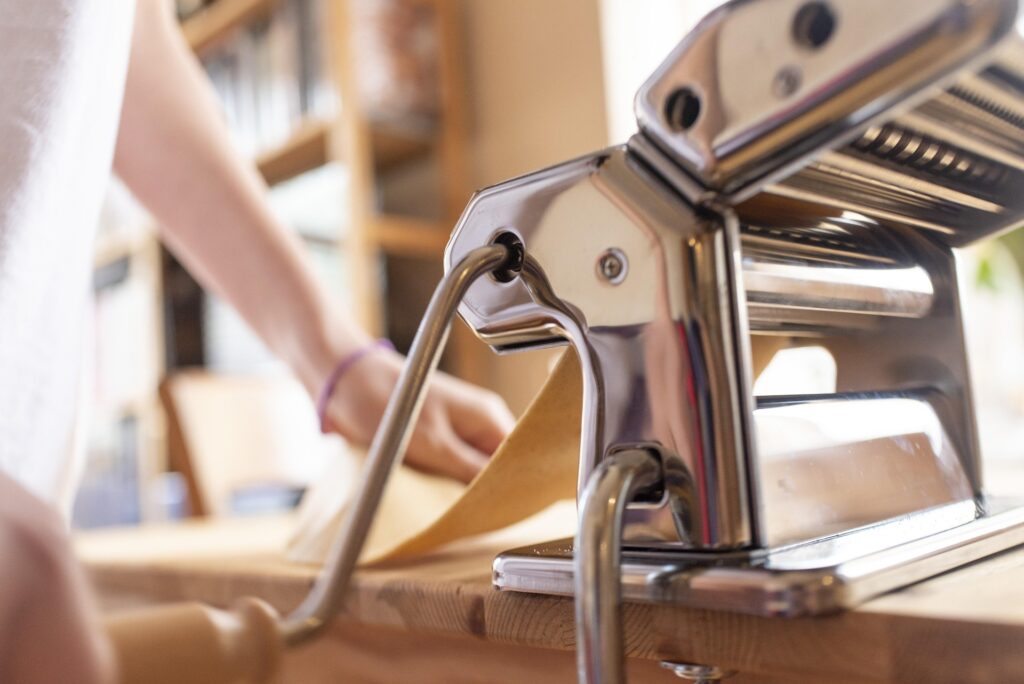
A hand-crank machine rolls dough to an even thickness, which is the hardest part of fresh pasta by hand. You pass the dough through at the widest setting, then step down one setting at a time. Skipping settings is the usual cause of torn sheets. Most machines also have cutters for noodles such as fettuccine and tagliolini.
The Marcato Atlas 150 is a widely used Italian model. We explain how it works in our Marcato Atlas 150 guide and compare it with Imperia in Marcato vs Imperia. Stand mixer owners can also buy roller attachments. A machine does not shape filled pasta, so you will still need a stamp or a knife for that.
2. Digital kitchen scale
Cups are unreliable for flour, because the weight of a cup depends on how packed it is. A scale removes that guesswork. A classic starting ratio for homemade egg pasta is about 100 g of flour to one large egg, and you adjust slightly for humidity and flour type. Look for a tare button, and a display that is still readable with a large bowl on top. Accuracy to the gram is enough for pasta.
3. Wooden board
A wide wooden board gives the dough some grip, so it does not slide while you knead, and it absorbs a little surface moisture. Look for a board at least about 60 by 90 cm if you have the space, and one with a lip that hooks over the counter edge so it stays still. You can also use a clean counter, but very cold stone surfaces can make dough stiffer to work.
4. Rolling pin
A long, thin wooden rolling pin (the Italian mattarello) lets you roll a big sheet of dough by hand. Many traditional cooks in Emilia-Romagna prefer it for ribbons like tagliatelle and for filled pasta, and some say it leaves the surface slightly rougher, which helps sauce cling. It takes practice, but it needs no machine. A plain straight dowel works too.
5. Bench scraper
A metal bench scraper cuts dough into portions, lifts a sticky mass off the counter, and scrapes up dried bits afterwards. It is cheap, takes almost no space and is useful for other kitchen jobs.
6. Fluted pastry wheel or ravioli stamp
A pastry wheel cuts straight or zigzag edges, which suits ravioli, lasagne sheets and farfalle. The pressed edge also helps seal filled pasta. For a closer look at filled-pasta tools, see our guide to ravioli makers. A gnocchi board or a small grooved paddle can add ridges to gnocchi and shapes like cavatelli and malloreddus.
7. Drying rack
A rack lets air reach every strand so noodles do not clump while the water comes to the boil. It also lets you dry pasta for storage. A broom handle between two chairs works in a pinch. Our guide to pasta drying racks explains the types and the drying times.
Habits that matter more than the gear
- Rest the dough. Wrap it and leave it for at least 30 minutes, so the gluten relaxes and it rolls smoothly.
- Dust with semolina. Its coarse grains keep dough from sticking without being absorbed the way plain flour is.
- Weigh your ingredients. Flour type and humidity vary, so adjust with a few drops of water or a little flour until the dough is firm but not crumbly.
- Do not wash tools in water. Let leftover dough dry, then brush it off. Water warps wood and can rust machine parts.
For help choosing flour, see our pasta flour guide, and for cooking the finished pasta, read pasta cooking, pasta water and common pasta mistakes.
What to buy first
- On a small budget: a scale, a bench scraper and a rolling pin. That is enough for noodles and ravioli.
- If you will make pasta regularly: add a hand-crank machine.
- If you love filled pasta: add a stamp or pastry wheel.
- Later: a drying rack and specialty boards.
Common questions
Do I need a pasta machine?
No. A rolling pin works, though it takes more practice and effort to get very thin, even sheets.
What is the best flour for fresh pasta?
Italian Tipo 00 flour is a common choice for egg pasta, often mixed with some semolina. See our flour guide for the details.
How should I store fresh pasta?
Dust it with semolina and keep it in the fridge for a day or two, or freeze it in a single layer and bag it once firm.
Can I use these tools for gluten-free pasta?
Yes, but gluten-free dough is more fragile and tears more easily. Roll it thicker.

Syed Yasar Arafat is the founder of PastaLoverz.com and a food research enthusiast with a focused interest in pasta varieties, traditional Italian cuisine, and balanced eating. Through PastaLoverz.com, he publishes well-researched articles that explain pasta types, cooking methods, and nutritional considerations in clear, practical terms to help readers make informed food choices.