
Marcato Atlas 150 vs Imperia is the ultimate comparison for home cooks seeking an authentic Italian experience. This decision often narrows down to these two titans of the industry. Choosing between these two iconic machines is not just about functionality; it is about selecting a tool that will become a staple in your kitchen for decades.
Both machines represent the pinnacle of Italian engineering, but they cater to slightly different preferences. If you demand precision, versatility, and modern aesthetics, the Marcato Atlas 150 often leads the conversation. Conversely, those who prioritize a traditional feel and heavy-duty, classic construction frequently lean toward the Imperia Pasta Maker.
At a Glance: Comparison Table
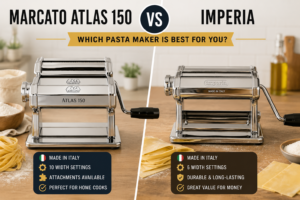
| Feature | Marcato Atlas 150 | Imperia Pasta Maker |
| Material | Anodized aluminum rollers | Chrome-plated steel |
| Thickness Settings | 10 settings (0.6mm to 4.8mm) | 6 settings |
| Expandability | High (13+ attachments) | Moderate |
| Aesthetics | Multiple colors available | Chrome only |
| Warranty | Up to 10 years | Usually 1 year |
| Best For | Precision and versatility | Traditional, heavy-duty feel |
Understanding the Marcato Atlas 150 vs Imperia Differences
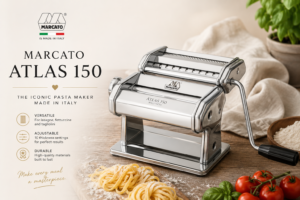
The Marcato Atlas 150 is widely considered the gold standard for home pasta makers. Its standout feature is the use of anodized aluminum rollers. Unlike chrome-plated alternatives, these rollers ensure that no harmful metallic particles transfer to your dough, making the Marcato Atlas 150 an excellent choice for health-conscious cooks.
When you use the Marcato Atlas 150, you immediately notice the precision. With 10 thickness settings, it offers granular control over your pasta sheets. This level of detail allows you to achieve the perfect translucent sheet for delicate ravioli or a thicker, heartier texture for traditional noodles. Furthermore, the Marcato Atlas 150 boasts an extensive ecosystem of attachments. Whether you want to make pappardelle, chitarra, or ravioli, the Marcato Atlas 150 ecosystem ensures you never run out of options.
Analyzing the Imperia Pasta Maker
The Imperia Pasta Maker is a testament to traditional design. It features a robust, chrome-plated steel construction that feels exceptionally solid on the countertop. Many users who have owned an Imperia Pasta Maker for decades report that the machine remains as functional as the day they bought it.
The Imperia Pasta Maker focuses on simplicity. It typically offers 6 thickness settings, which, while fewer than its rival, is perfectly adequate for most standard pasta recipes. The tactile experience of using an Imperia Pasta Maker is often described as “classic.” It uses a straightforward mechanism that provides a satisfying, heavy-duty cranking motion. For those who want a reliable, no-frills workhorse, the Imperia Pasta Maker remains a beloved choice.
Key Differences for Your Workflow
1. Precision and Thickness
If you are a perfectionist, the Marcato Atlas 150 provides superior control. The extra thickness settings allow for a finer degree of adjustment, which is critical when developing high-level pasta techniques. While the Imperia Pasta Maker is consistent, it lacks the fine-tuned range that advanced hobbyists often desire.
2. Durability and Maintenance
Both machines are durable, but their maintenance differs. The Marcato Atlas 150 benefits from anodized rollers that resist oxidation. Users must still avoid water, but the materials are inherently cleaner. The Imperia Pasta Maker, being chrome-plated, is incredibly sturdy, though it requires vigilant care to prevent any potential rust over very long periods of use.
3. Expandability
The Marcato Atlas 150 wins decisively in the versatility category. Because Marcato has standardized its attachment system, you can easily scale up your equipment as your skills evolve. While you can add accessories to the Imperia Pasta Maker, the variety and availability of those add-ons are generally more limited compared to the expansive Marcato catalog.
Expert Insights: Marcato Atlas 150 vs Imperia Comparison
When considering the Marcato Atlas 150, focus on your long-term goals. Do you plan to explore a wide variety of pasta shapes? If so, the Marcato Atlas 150 is the investment that grows with you. Its reputation for longevity is supported by a superior warranty structure, making the Marcato Atlas 150 a safer financial bet over time.
When considering the Imperia Pasta Maker, think about your kitchen aesthetic and workflow. If you prefer a classic, heavy-duty machine that feels like a family heirloom and you primarily make standard noodles, the Imperia Pasta Maker will likely satisfy every requirement you have.
Ultimately, if you want the best of both worlds—a machine that is easy to use, highly precise, and visually modern—you will find that the Marcato Atlas 150 fits the bill perfectly. Even for beginners, the Marcato Atlas 150 offers a more forgiving experience because the roller tension is meticulously consistent.
Frequently Asked Questions (FAQs)
Can I wash my pasta machine with water? Never use water on either the Marcato Atlas 150 or the Imperia . Water can cause rust and damage the internal gears. Use a dry brush or a small cloth to remove flour.
Which machine is easier to store? Both have similar footprints, but the Marcato Atlas 150 often feels slightly more compact due to its design.
Do these machines work with gluten-free dough? Yes, both the Marcato Atlas 150 and the Imperia pasta maker can handle gluten-free dough, provided the dough is properly hydrated and not too sticky.
Is the motor attachment necessary? While not necessary, many users prefer the Marcato Atlas 150 motor for long sessions, as it frees up both hands to guide the pasta sheets.
Why is the Marcato Atlas 150 more expensive? The higher cost of the Marcato Atlas 150 is largely attributed to its advanced anodized material construction and its significantly longer warranty period.
Which is better for beginners: Marcato Atlas 150 vs Imperia? Both are excellent, but the Marcato Atlas 150 vs Imperia debate often highlights the Marcato’s slightly easier learning curve due to its consistent roller tension.
Are the rollers interchangeable in the Marcato Atlas 150 vs Imperia? No, you cannot use attachments interchangeably; when researching Marcato Atlas 150 vs Imperia, ensure you choose accessories specifically designed for your model.
How does the warranty compare in the Marcato Atlas 150 vs Imperia? The Marcato Atlas 150 vs Imperia comparison favors Marcato, which typically offers a 10-year warranty compared to the standard one-year warranty often found with the Imperia.
Deep Dive FAQs: Marcato Atlas 150 vs Imperia
As you finalize your purchasing decision, you likely have highly specific questions about how these machines perform under demanding culinary scenarios. Here are advanced insights into the Marcato Atlas 150 vs Imperia debate to help you make the most informed choice for your kitchen.
Does the Marcato Atlas 150 vs Imperia debate matter specifically for making ravioli and stuffed pastas? Yes, it absolutely matters. When you prepare stuffed pastas like ravioli, tortellini, or agnolotti, your dough must be exceptionally thin and pliable so the folded edges do not become tough when boiled.
In the Marcato Atlas 150 vs Imperia comparison, the Marcato Atlas 150 holds a distinct advantage. Its 10-position dial allows you to roll the dough progressively thinner in smaller micro-increments, drastically reducing the risk of tearing delicate sheets. Furthermore, Marcato offers a highly rated, dedicated ravioli attachment that integrates seamlessly with the Atlas 150, making the filling process much more streamlined for home cooks.
Which machine handles stiff or low-hydration doughs better? If you frequently make extruded-style pasta doughs at home or work with very low-hydration semolina recipes, stability becomes your primary concern. When evaluating the Marcato Atlas 150 vs Imperia for heavy-duty tasks, the Imperia Pasta Maker often takes the lead. Weighing in at over seven pounds, the Imperia boasts a heavy, industrial-grade steel body that stays firmly planted on your countertop. While both machines include secure table clamps, the sheer mass of the Imperia prevents the machine from wobbling or shifting when you crank thick, stubborn dough through the widest roller settings.
How do the motor attachments compare in the Marcato Atlas 150 vs Imperia ecosystem? Adding a motor to your manual pasta maker transforms it into a semi-automatic production powerhouse, freeing up both of your hands to gently guide the pasta sheets. The Marcato Atlas 150 vs Imperia motor showdown features the Marcato PastaDrive against the Imperia PastaFacile.
Both motors are excellent, but the Marcato PastaDrive utilizes a patented bayonet fitting that locks securely into the machine without requiring extra brackets or complex installation. Users generally find the Marcato motor slightly quieter and more intuitive to attach and remove during busy cooking sessions.

Is there a significant price difference when choosing between the Marcato Atlas 150 vs Imperia? Budget is a crucial factor for any kitchen investment. Generally, when you look at the Marcato Atlas 150 vs Imperia price points, the Marcato Atlas 150 carries a slightly higher initial price tag. This premium accounts for the patented anodized aluminum rollers, the sleek aesthetic finishes, and the extensive 10-year warranty.
The Imperia is often more budget-friendly upfront, appealing to cooks who want professional-grade steel construction without the extra modern frills. However, when you factor in the Marcato’s decade-long warranty guarantee, the long-term value between the two machines balances out significantly.
Can I easily find replacement parts for both brands? Because both brands possess a massive global footprint and decades of manufacturing history, finding replacement parts is relatively stress-free. In the Marcato Atlas 150 vs Imperia longevity test, both pass with flying colors. You can readily purchase replacement table clamps, crank handles, and individual cutting heads for both models online. Marcato’s standardized design across the Atlas line means parts from newer models often fit older bases perfectly, ensuring your machine never becomes obsolete even if you lose a piece.
How do I choose between the Marcato Atlas 150 vs Imperia if I want to make alternative grain pastas? Alternative flours like buckwheat, chickpea, or lentil flour lack the natural elasticity that traditional wheat gluten provides. This makes the dough incredibly fragile and prone to crumbling as it passes through the machine. For this specific use case, the Marcato Atlas 150 vs Imperia choice leans toward the Marcato.
The anodized aluminum rollers of the Marcato feature a microscopic roughness that grips the dough slightly better than high-gloss chrome, pulling fragile alternative-grain doughs through the machine more consistently. Additionally, the finer micro-adjustments on the Marcato dial prevent you from forcing the dough too thin too quickly, which is the primary cause of tearing in gluten-free pasta making.
What does long-term maintenance look like in the Marcato Atlas 150 vs Imperia comparison? Maintaining your pasta maker is the key to ensuring it lasts long enough to pass down to the next generation. When comparing the Marcato Atlas 150 vs Imperia maintenance routines, the core rule remains the same: never submerge them in water. However, the Marcato Atlas 150 features removable polymeric resin combs and scrapers underneath the rollers.
These can be easily slid out and wiped down with a dry cloth, making it incredibly simple to remove trapped flour and dough particles. The Imperia relies on fixed scrapers that require a stiff brush and a bit more manual effort to clean out thoroughly. Over years of heavy use, the Marcato’s design prevents the buildup of rancid flour oils much more effectively.
The Legacy Behind the Brands: Marcato Atlas 150 vs Imperia
To truly understand the Marcato Atlas 150 vs Imperia debate, it is helpful to look at the rich culinary heritage that birthed both of these iconic machines. Both companies emerged in Italy during the mid-20th century, a time when there was a massive push to bring the quality of professional, trattoria-style pasta into the domestic kitchen.
For generations, Italian nonnas rolled out their sfoglia (pasta sheets) entirely by hand using a long wooden rolling pin. The introduction of these manual crank machines revolutionized home cooking, allowing home chefs to achieve perfectly uniform thickness in a fraction of the time.
The engineering philosophies of the two companies highlight why the Marcato Atlas 150 vs Imperia comparison remains so relevant today. Marcato, founded in the province of Padua, has always leaned heavily into innovation and modernization. Their patented use of anodized aluminum for the rollers was a massive leap forward in kitchen safety and cleanliness
By ensuring that no heavy metals could oxidize and transfer onto the dough, Marcato appealed to a newer generation of health-conscious cooks who still wanted an authentic cooking experience. Their design language is sleek, refined, and constantly evolving to include new attachments and modern colorways that fit seamlessly into contemporary kitchen aesthetics.
On the other side of the Marcato Atlas 150 vs Imperia spectrum sits the Imperia brand, which originated in Turin. Imperia took the approach that if something is built perfectly the first time, it never needs to change. Their machines are synonymous with industrial-strength tradition.
The heavy-duty, chrome-plated steel body is designed to mimic the robust machinery found in old-school Italian bakeries and pasta shops. When you look at an Imperia machine, you are looking at a piece of equipment that has remained virtually unchanged for decades, cherished for its utilitarian beauty and unstoppable reliability.
The sensory experience of using these machines also plays a massive role in the Marcato Atlas 150 vs Imperia decision-making process. When you feed a rich, egg-based dough through the Marcato Atlas 150, the crank turns with a smooth, engineered glide.
The transition between thickness settings clicks into place with satisfying, lightweight precision. Conversely, the Imperia offers a deeply tactile, mechanical resistance. Turning the handle on an Imperia requires a bit more effort, but it rewards the user with a heavy, grounded feeling that connects you directly to the physical transformation of the dough. Both experiences are incredibly rewarding, transforming simple flour and eggs into a culinary masterpiece.
Summary
The choice in the Marcato Atlas 150 vs Imperia battle ultimately comes down to your personal cooking style. The Marcato Atlas 150 provides a modern, versatile, and high-precision experience perfect for those who want to expand their culinary repertoire over time. The Imperia, meanwhile, offers a robust, traditional, and heavy-duty feel that appeals to those who value simplicity and long-lasting, classic equipment. By reviewing the core differences in this Marcato Atlas 150 vs Imperia guide, you are now equipped to make an informed decision for your kitchen.
Conclusion
Investing in a high-quality pasta machine is a transformative step for any home cook. Throughout this Marcato Atlas 150 vs Imperia breakdown, we have explored why both machines have earned their place in kitchens globally. While the Marcato Atlas 150 vs Imperia decision might seem challenging, both tools are capable of producing restaurant-quality results. Whether you prioritize the expansive attachment system of the Marcato or the steadfast, industrial-grade construction of the Imperia, your final choice in the Marcato Atlas 150 vs Imperia comparison will undoubtedly lead to many delicious, homemade meals for years to come.

Pro Tip for Perfect Pasta
Regardless of whether you choose the Marcato Atlas 150 or the Imperia , the secret to perfect sheets is in the flour dusting. Always lightly dust your dough with fine semolina flour before feeding it through the rollers. This prevents the dough from sticking and ensures a smooth, consistent output every single time. As you gain more experience, you will find that a well-maintained Marcato Atlas 150 or Imperia allows you to focus entirely on the quality of your ingredients rather than the limitations of your tools.
Check out more Marcato Atlas 150 Review: 1 Best Pasta Maker
and 7 Essential Tools for Homemade Pasta (Perfect Results)
In-Depth Feature Breakdown: Marcato Atlas 150 vs Imperia
When making your final decision in the Marcato Atlas 150 vs Imperia debate, reviewing the exact technical specifications side-by-side can be incredibly helpful. Here is how these two legendary machines stack up across every major category:
| Feature | Marcato Atlas 150 | Imperia Pasta Maker |
| Body Construction | Chrome-plated steel (available in multiple colored aluminum finishes) | Heavy-duty chrome-plated steel |
| Roller Material | Anodized aluminum (prevents metal residue on dough) | Chrome-plated steel |
| Thickness Settings | 10 settings (approx. 0.6mm to 4.8mm) | 6 settings (approx. 0.2mm to 2.2mm) |
| Maximum Dough Width | 150mm (about 6 inches) | 150mm (about 6 inches) |
| Motor Compatibility | Yes (Compatible with the Marcato PastaDrive motor) | Yes (Compatible with the Imperia PastaFacile motor) |
| Expandability | High (13+ compatible extra attachments available) | Moderate (Standard attachments, fewer extra options) |
| Cleaning Method | Dry brush, wooden skewer, or cloth only (Never use water) | Dry brush or cloth only (Never use water) |
| Machine Weight | Approx. 3 lbs (lighter and easier to move) | Approx. 7.5 lbs (heavy, grounded, and very sturdy) |
| Manufacturer Warranty | 10 years (industry-leading protection) | Typically 1 year |
| Overall Aesthetic | Modern, sleek, and highly customizable | Classic, traditional, and industrial |

Syed Yasar Arafat is the founder of PastaLoverz.com and a food research enthusiast with a focused interest in pasta varieties, traditional Italian cuisine, and balanced eating. Through PastaLoverz.com, he publishes well-researched articles that explain pasta types, cooking methods, and nutritional considerations in clear, practical terms to help readers make informed food choices.

2 Responses