
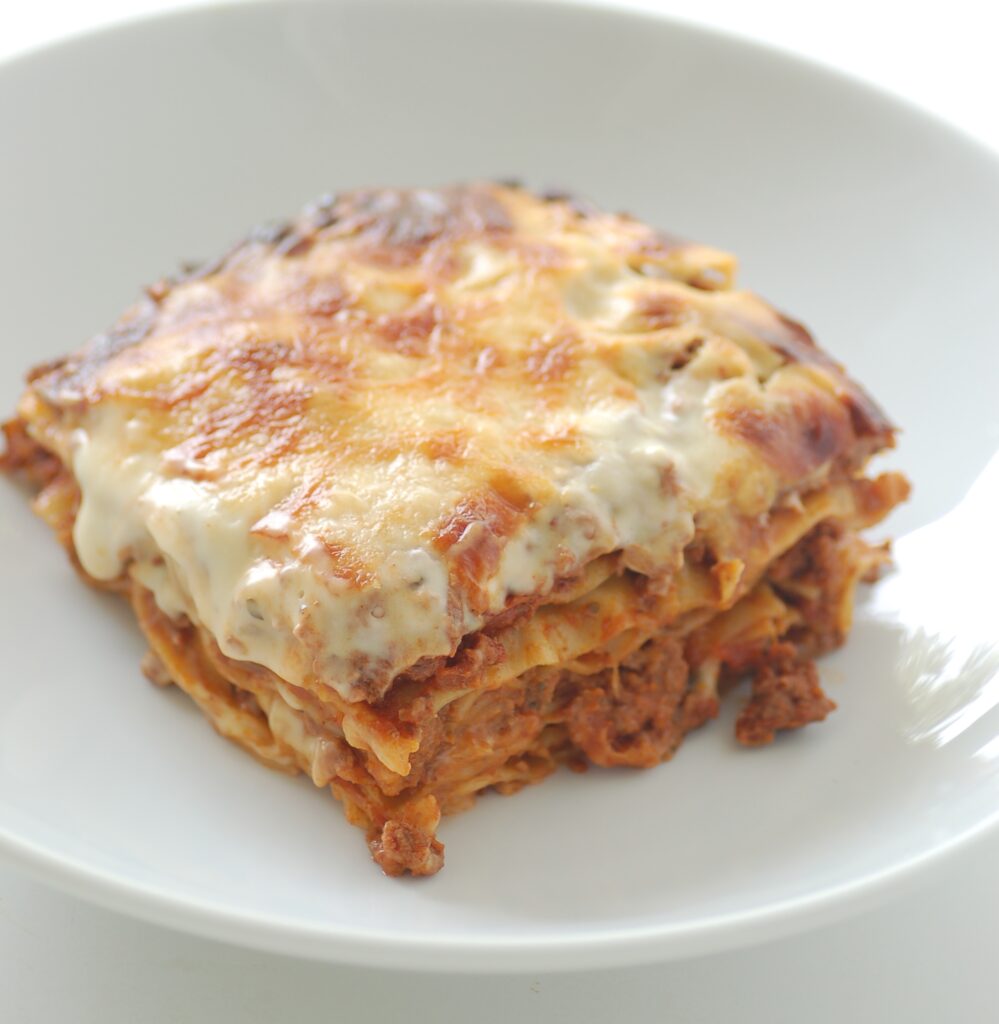

This is the American-Italian style of lasagna: a beef tomato sauce, a ricotta filling bound with egg, plenty of mozzarella and a golden top. It serves 8, holds clean layers when sliced, and keeps well in the fridge and freezer, so it suits family dinners and make-ahead meals. It differs from the traditional Bologna version, which uses a slow-cooked ragù, béchamel and Parmigiano Reggiano and no ricotta. For that style, see our lasagna Bolognese recipe.
Recipe at a glance
- Serves: 8
- Dish: deep 9 x 13 inch (about 23 x 33 cm) ceramic or glass baking dish
- Sauce: about 45 minutes in total, including a 30-minute simmer
- Bake: 45 to 50 minutes at 180 °C (350 °F), then rest for 15 to 20 minutes
How the layers work
- Thin sauce layer on the bottom stops the sheets sticking.
- Pasta sheets soak up flavour from the sauce around them.
- Ricotta filling adds creaminess. Whisking in an egg helps it set as it heats, so slices hold together instead of running.
- Mozzarella and Parmesan on top melt and brown into the crust.
The main cause of watery lasagna is a loose sauce. Tomatoes carry a lot of water, so simmering the meat sauce for at least 30 minutes concentrates it before it goes into the dish. Slightly undercooking the sheets lets them finish in the oven by absorbing extra moisture.
Ingredients
Meat sauce
- 2 tablespoons extra-virgin olive oil
- 500 g lean ground beef (85/15 or 90/10)
- 1 medium yellow onion, finely diced
- 3 garlic cloves, minced
- 800 g canned crushed tomatoes
- 2 tablespoons tomato paste
- 1 teaspoon dried oregano and 1 teaspoon dried basil
- Salt and freshly ground black pepper
Cheese filling
- 500 g whole-milk ricotta
- 1 large egg
- 1 cup (about 100 g) finely grated Parmesan, plus extra for the top
- 2 cups (about 200 g) shredded low-moisture mozzarella, plus 1 cup for the top
To assemble
- 12 standard lasagna sheets
- A little oil for the dish
Method
1. Make the meat sauce
- Heat the oil in a large heavy skillet or Dutch oven over medium heat. Cook the onion for 3 to 4 minutes until soft, then add the garlic for about a minute.
- Add the beef and break it into fine crumbles. Cook for 6 to 8 minutes until no pink remains, and drain excess fat if there is a lot. Ground beef should reach 71 °C (160 °F).
- Stir in the tomato paste and cook for a minute. Add the crushed tomatoes, oregano, basil, salt and pepper.
- Reduce the heat, partly cover, and simmer for 30 minutes, stirring now and then, until thick.
2. Mix the cheese filling
In a bowl, combine the ricotta, egg and Parmesan until smooth. Fold in 1 cup of the mozzarella and season with a pinch of salt and pepper.
3. Cook the pasta
Boil the sheets in well-salted water for about 2 minutes less than the packet says, so they are not fully tender. Drain gently and lay them flat on parchment or clean towels so they do not stick. If your sheets are no-boil, skip this step and add a little extra sauce instead. See how to cook pasta and pasta water for more.
4. Assemble
Heat the oven to 180 °C (350 °F) and lightly oil the dish.
- Spread about ½ cup of sauce thinly over the bottom.
- Lay 3 to 4 sheets over it, overlapping the edges slightly.
- Spread a third of the ricotta mixture, then a layer of sauce, then a handful of mozzarella.
- Repeat the layers twice more.
- Finish with a layer of sheets, the remaining sauce, the remaining mozzarella and some extra Parmesan.
Keep the layers even and cover the corners, so the edge sheets cook through.
5. Bake and rest
- Cover loosely with foil, tented so it does not touch the cheese, and bake for 30 minutes.
- Remove the foil and bake for another 15 to 20 minutes, until the top is golden and bubbling at the edges.
- The lasagna is done when it is steaming hot in the centre, at least 74 °C (165 °F).
- Rest it for 15 to 20 minutes before cutting. The layers set and the juices settle, which gives clean slices.
Common problems and fixes
- Watery lasagna: the sauce was too thin or the dish was cut too soon. Simmer longer and rest it.
- Layers that slide: too much sauce in each layer. Spread thin, even layers.
- Dry edges: sheets not covered by sauce, or too little foil time. Cover the corners and bake covered for the first half.
- Grainy ricotta: over-baking. The egg and Parmesan in the filling help it stay smooth.
Variations
- Beef and sausage: swap half the beef for mild Italian pork sausage with the casings removed. It adds fennel and garlic flavour, and must also be fully cooked.
- Vegetable: add sauteed, well-drained spinach or mushrooms to the filling.
- Extra crust: sprinkle a little Parmesan over the top for the last 5 minutes of baking.
Nutrition (estimate)
These are approximate values per serving (1 of 8) using whole-milk dairy and lean beef. Your numbers will vary by brand and portion size.
| Nutrient | Approximate amount per serving |
|---|---|
| Calories | About 690 kcal |
| Protein | About 39 g |
| Carbohydrate | About 43 g |
| Fat | About 38 g |
Storing, freezing and reheating
- Fridge: cool, then store in airtight containers for up to 4 days.
- Freeze unbaked: assemble in a freezer-safe dish, wrap tightly in plastic and foil, and freeze for up to 3 months. Thaw overnight in the fridge before baking.
- Freeze baked slices: wrap single portions in parchment and foil, and store in freezer bags. Reheat from frozen at 180 °C (350 °F) for 25 to 30 minutes.
- Reheat until steaming hot throughout, at least 74 °C (165 °F). Covered in the oven at 175 °C (350 °F) for about 15 minutes works for single portions.
Related guides
- Lasagna Bolognese, the traditional style
- Lasagne verdi, the green spinach sheets
- Pasta alla Sorrentina, an easier baked pasta
- Pasta portion calculator
Further reading: Wikipedia: Lasagna

Syed Yasar Arafat is the founder of PastaLoverz.com and a food research enthusiast with a focused interest in pasta varieties, traditional Italian cuisine, and balanced eating. Through PastaLoverz.com, he publishes well-researched articles that explain pasta types, cooking methods, and nutritional considerations in clear, practical terms to help readers make informed food choices.