
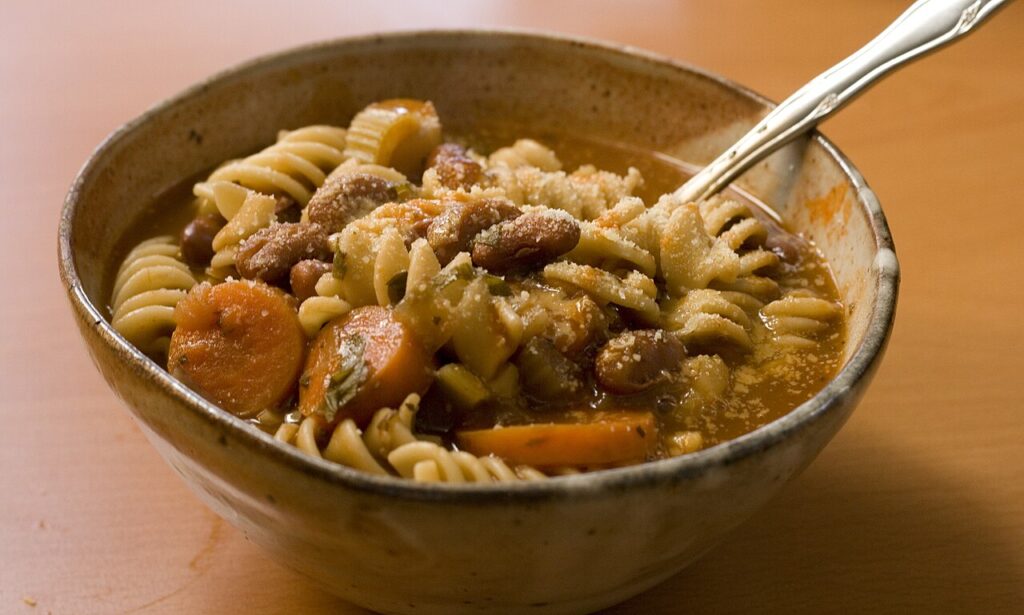

Minestrone is a thick Italian vegetable soup, usually with beans, and often with a handful of small pasta or rice. The best pasta for minestrone is small and sturdy: ditalini and other short tubes are the classic choice, because they hold their shape in a long-simmered soup and fit neatly on a spoon alongside the beans and vegetables.
Quick answer: ditalini or tubetti first, then small shells, small elbow macaroni or anelli. Broken spaghetti or a mix of leftover short pasta is a traditional home-cook option. Some regional versions, such as minestrone alla milanese, use rice instead of pasta.
The best pasta for minestrone
| Pasta | Why it works | Keep in mind |
|---|---|---|
| Ditalini or tubetti | Small, sturdy tubes that hold broth inside | The most common choice |
| Small shells | Cup shape scoops up beans and vegetables | Choose the smallest size you can find |
| Small elbow macaroni | Firm bite, easy to find | Use a small size so pieces stay spoon-sized |
| Anelli or anellini | Little rings that hold their shape | Make a slightly finer soup |
| Broken spaghetti | A traditional way to use up odds and ends | Break into short pieces first |
| Mixed short pasta | Uses up leftover packets | Add longer-cooking shapes first |
| Short spirals (fusilli or rotini) | Chunky and hearty | Larger, so use less |
| Orzo | Gives a softer, finer texture | Absorbs broth quickly |
| Rice | Used in some regional versions; gluten-free | Takes longer and thickens the soup |
Why small, sturdy shapes work best
Minestrone is usually simmered for a long time and is often eaten the next day, when the flavours have developed. Thin or delicate pasta breaks down in that time. Small semolina shapes such as ditalini, small shells and elbow macaroni keep a pleasant bite, and their size matches the diced vegetables and beans, so every spoonful has a bit of everything.
How much pasta to add
Pasta is one ingredient among many in minestrone, so you need much less than for a pasta dish. As a rough guide, allow about 25 to 40 g of dry pasta per person. Too much pasta turns the soup into a thick stew as it absorbs the broth, especially overnight.
When to add the pasta
- Cook the vegetables and beans first, until they are nearly tender and the broth has good flavour.
- Add the pasta for the last stretch of cooking, following the packet time, and stir now and then so it does not stick to the bottom.
- Taste early. The pasta should be just tender, as it keeps softening in the hot soup.
- For leftovers, cook the pasta separately and add it to each bowl when serving, or keep some extra broth to loosen the soup when you reheat it.
Minestrone and pasta e fagioli
The two soups are close relatives. Pasta e fagioli is built mainly around beans and pasta, while minestrone has a wider mix of vegetables. Both suit the same small shapes, and ditalini is a favourite in each.
Gluten-free options
Rice is the simplest gluten-free choice and is traditional in some regional versions. Gluten-free small pasta also works, but it can break down faster in a long-simmered soup, so add it near the end or cook it separately. Check labels if you are cooking for someone with coeliac disease.
Common questions
What pasta is traditionally used in minestrone?
Small short pasta such as ditalini or tubetti is the most common choice. Many Italian households also use broken spaghetti or a mix of leftover short pasta, and some regional versions use rice instead.
Can I use orzo in minestrone?
Yes. It gives a softer, finer soup. Add it near the end, as it absorbs broth quickly.
Why does minestrone get thick overnight?
The pasta keeps soaking up broth as the soup sits. Store the pasta separately, or add a splash of water or stock when you reheat it.
Can I make minestrone without pasta?
Yes. It is still a complete soup with beans and vegetables, and you can add rice, barley or a piece of crusty bread instead.
Keep exploring
See our guides to the best pasta for soup, the best pasta for chicken noodle soup and ditalini substitutes.
Further reading: Wikipedia: Minestrone

Syed Yasar Arafat is the founder of PastaLoverz.com and a food research enthusiast with a focused interest in pasta varieties, traditional Italian cuisine, and balanced eating. Through PastaLoverz.com, he publishes well-researched articles that explain pasta types, cooking methods, and nutritional considerations in clear, practical terms to help readers make informed food choices.