
Pasta looks like a single invention, but its story is really a long chain of small steps: wheat farming, new ways of making dough, dry storage, trade routes, a New World vegetable and, finally, factories. Some of the most repeated stories about it are myths, and some of the details are still argued over by historians. This guide separates what is well established from what is debated.
The Marco Polo myth
The best-known story says Marco Polo brought pasta from China to Italy in 1295. Historians reject it. Pasta in Italy is documented well before his return, and the legend is generally traced to a 1929 article in an American trade magazine for the macaroni industry. Noodles and pasta developed in several places independently.
The oldest noodles found so far are about 4,000 years old. They were made from millet and were excavated at the Lajia site in northwest China. That discovery shows that noodle-making is very old, but it does not connect to Italian durum pasta.
Early forms in the Mediterranean
Ancient Greeks and Romans made flat sheets of dough from wheat. The Roman lagana, mentioned in ancient texts, is often described as an ancestor of lasagne, although it was a flatbread-like sheet and not a boiled noodle. Some writers point to tomb carvings from Etruscan Italy that show tools and dough, but whether these show pasta making is debated.
Sicily and dried pasta
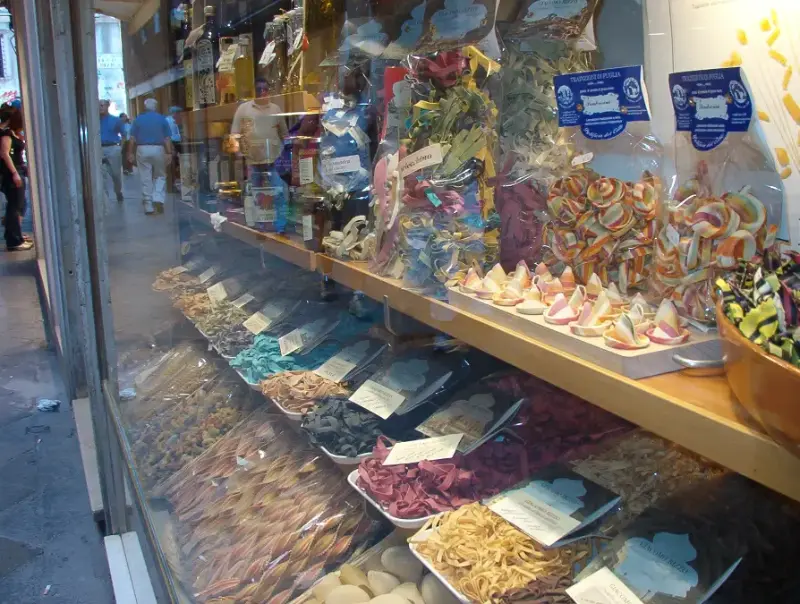
Dried pasta is where the Italian story becomes better documented. In 1154 the Arab geographer al-Idrisi described a factory in Trabia, near Palermo, producing a dried, string-shaped food called itriyya that was exported across the Mediterranean. Sicily was under Arab rule in earlier centuries, and many historians credit Arab trade and technique with spreading dry pasta. Others argue that parts of the tradition were already present in southern Italy. What is clear is that by the 12th century, Sicily was producing and exporting dried pasta from durum wheat.
Drying was the breakthrough. It turned a perishable dough into something that could be stored for months and carried on ships.
Naples becomes the “macaroni” city
In the 1600s and 1700s, the people of Naples shifted from a reputation as “leaf eaters” to mangiamaccheroni, “macaroni eaters”. A growing population and costly meat made a cheap, filling food attractive. Pasta makers adopted presses to push dough through dies, and the area around Naples, including the town of Gragnano, became known for it. Local accounts often credit the sea air and winds for helping the pasta dry well, though modern producers use controlled drying rooms.
The tomato arrives
Tomatoes came from the Americas and were slow to enter Italian cooking. Tomato sauces appear in Italian cookbooks in the late 1700s, and a Neapolitan cookbook by Ippolito Cavalcanti (first published in 1837, with an expanded edition in 1839) is frequently cited for an early recipe for pasta with tomato. The pairing then became the dish most people now picture. For examples, see our guides to classic pasta sauces and Italian sauces by region.
Industry and mass production
In the 19th century, mechanical kneaders, hydraulic presses and controlled drying rooms replaced hand work and simple wooden screw presses. Pasta could be made in volume at a consistent quality, and Italian factories began to export it widely. Bronze dies were standard for a long time. In the 20th century, Teflon-coated dies became common because they are faster and cheaper. They give a smoother surface, which is the main reason many cooks still prefer bronze-cut pasta. See our guide to bronze-cut and Teflon pasta.
Pasta travels west
Thomas Jefferson encountered “macaroni” while serving as a diplomat in France in the 1780s and arranged for a pasta mould or machine to be sent home to Virginia. A dish described as a macaroni pie was served at an official dinner in 1802. The much larger wave came with Italian emigration in the late 19th and early 20th centuries. Immigrants in the United States and elsewhere adapted dishes to local ingredients, producing Italian-American classics such as spaghetti and meatballs. In Italy, regions kept their own shapes and sauces, which is part of why there are so many today. Our regional pasta guide looks at that variety.
Shapes today
Italy has hundreds of traditional shapes, and counts vary depending on how local names are treated. Many were designed to suit particular sauces, which is the subject of our pasta shapes guide and pairing guide. For one historic type, see our guide to testaroli, sometimes called one of the oldest pasta shapes, and for a hand-pulled example, maccheroni alla molinara.
Quick timeline
| Period | Development |
| About 2000 BCE | Millet noodles in China (Lajia) |
| Roman era | Lagana, sheets of dough, an ancestor of lasagne |
| 1154 | Al-Idrisi records dried pasta production at Trabia in Sicily |
| 1600s to 1700s | Naples becomes a pasta centre; presses spread |
| 1830s | Neapolitan cookbook records pasta with tomato |
| 1800s | Factories, mechanical presses and mass drying |
| Late 1800s to early 1900s | Mass migration spreads pasta worldwide |
| 1900s | Smooth dies, whole-grain and gluten-free products |
Common questions
Who invented pasta?
No single person did. It developed over centuries, in several places.
Did the Chinese or the Italians invent pasta first?
Noodles in China are older, but Italian pasta made from durum wheat developed on its own.
What is the oldest pasta?
Lagana is often named as an early relative, and testaroli is another contender, though neither is a simple answer.
What is the difference between pasta and noodles?
Pasta is traditionally made from durum wheat semolina and is mostly Italian. Noodles is a broader term for many dough strands made from wheat, rice or starch.
Why did Naples matter?
It combined a large, hungry population, new presses and good drying conditions, which turned pasta into a cheap daily food.
When was the tomato added?
Tomato sauces appear in Italian cookbooks from the late 1700s, and pasta with tomato is recorded in the 1830s.
Keep reading
For the practical side, our guides to pasta types, pasta cooking and the four classic Roman pastas connect this history to your kitchen.
Historical dates and attributions vary between sources. For further reading, see the Encyclopaedia Britannica entry on pasta.

Syed Yasar Arafat is the founder of PastaLoverz.com and a food research enthusiast with a focused interest in pasta varieties, traditional Italian cuisine, and balanced eating. Through PastaLoverz.com, he publishes well-researched articles that explain pasta types, cooking methods, and nutritional considerations in clear, practical terms to help readers make informed food choices.