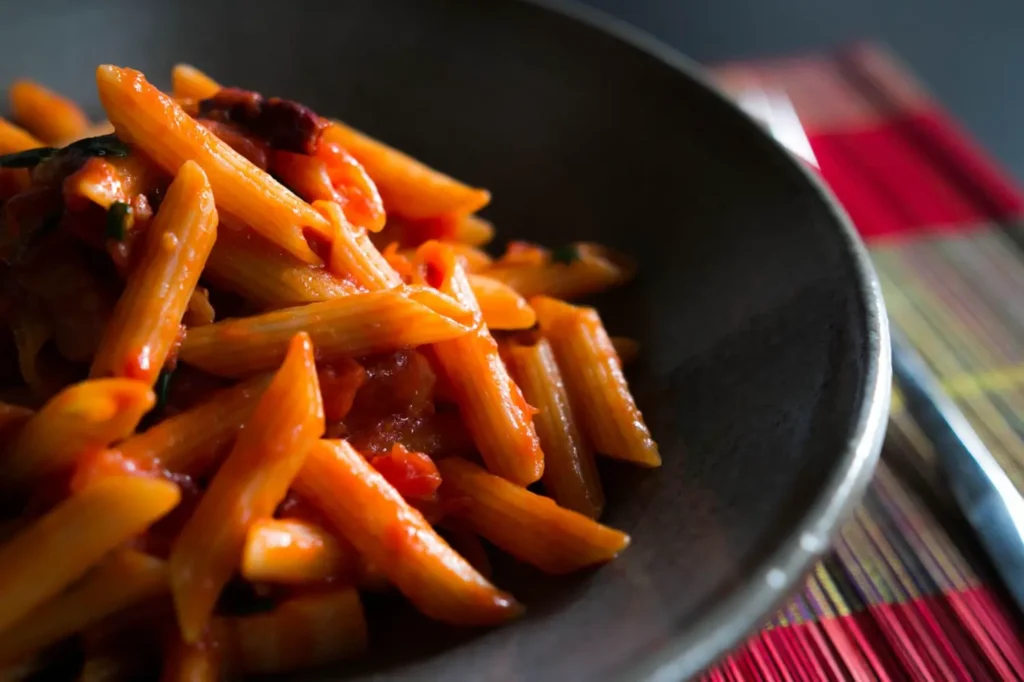
Two packets of spaghetti can look almost the same on the shelf and cook very differently. One reason is the die, the metal plate that shapes the dough. Pasta pushed through bronze dies has a rough, matte surface, while pasta pushed through Teflon-coated dies is smoother and shinier. This guide explains what each term means, how they affect sauce and texture, where the claims are well supported and where they are exaggerated, and how to choose.
How dried pasta is made
Commercial dried pasta starts as a stiff dough of durum wheat semolina and water. A large extruder forces it through a die, a perforated plate with shaped openings, and a rotating blade cuts the strands or shapes to length. The pieces are then dried before packing. The material that lines the die changes how the dough moves through it, and so the finish of the pasta.
Bronze-cut (bronze die)
Bronze dies, sometimes brass, create more friction as the dough passes through. The result is a rougher, slightly floury surface with a paler, matte colour. In Italian this is called trafilata al bronzo. Bronze dies are more expensive and more labour-intensive to make and maintain, and they are often associated with smaller or traditional producers.
Teflon-extruded
Teflon (PTFE) lined dies are slicker, so dough slides through more easily and faster. The surface comes out smoother and shinier, with a slightly more uniform yellow. These dies are cheaper to run and common in high-volume production.
| Feature | Bronze die | Teflon die |
| Surface | Rough, matte, slightly dusty | Smooth, shiny |
| Colour | Paler | Often deeper yellow |
| Sauce grip | Usually better | Usually less |
| Cost | Usually higher | Usually lower |
| Typical producers | Artisan and traditional brands | Large-scale manufacturers |
What the difference does at the table
Sauce cling
This is the best-supported benefit. A rougher surface gives sauce more to hold on to, so oil, cheese and ragù stay on the pasta instead of sliding off into the bowl. The effect is easiest to notice with simple sauces where nothing else is holding things together, for example cacio e pepe, and with heavy sauces like meat ragù. Tossing the pasta in the pan with a splash of starchy cooking water makes any pasta cling better, as explained in our mantecatura guide and pasta water guide.
Starch in the water
Rough pasta is often said to release more starch, which makes the water better for finishing sauces. This can be true, but the amount depends on the brand, the flour and how much water you use. See starchy pasta water.
Texture and cooking time
Many bronze-die brands are also dried slowly at lower temperatures, and cooks often describe a firmer, chewier bite and a slightly longer cooking time. This comes from the drying and the flour as much as the die, so it varies. Always follow the packet and taste a minute or two early.
Flavour and grain quality
Producers who use bronze dies often emphasise high-quality semolina and slow drying, and some pasta fans taste a more wheaty flavour. But a bronze die does not guarantee better wheat, and good pasta is also made with Teflon dies. Blind taste tests of pasta generally show smaller differences than marketing suggests, so the best choice is the one you enjoy.
Drying: slow or fast
Drying matters as much as the die. Traditional producers often dry pasta slowly at lower temperatures over a day or more, while large factories dry at higher temperatures in a few hours. Slow drying is thought to preserve more flavour and give a firmer texture, but modern high-temperature drying is also widely used and can give a good result when the process is controlled. If a brand does not say how it dries, that is not a sign of poor quality.
Price
Bronze-die pasta usually costs more, often a few times as much per packet as standard brands, though prices vary by country and shop. A packet makes several servings, so the extra cost per person is small. It makes most sense for dishes where the pasta is the star.
When each type works well
Choose bronze-die when
- The sauce is simple or oil-based, such as cacio e pepe or gricia. See the four Roman pastas.
- You are making a thick ragù or a chunky sauce. See pasta pairing.
- The shape is twisted or ridged, such as gemelli, campanelle or bucatini.
Teflon-extruded is fine when
- You are making cold pasta salad, soups, or baked dishes where cheese and sauce do most of the work, such as baked ziti.
- Budget matters.
- You want a smooth, uniform look in a dish with broth.
How to spot bronze-die pasta
- Look for trafilata al bronzo, “bronze die” or “bronze cut” on the packaging.
- The pasta looks pale, matte and slightly dusty.
- Check the label and the maker’s website. Appearance alone is not proof.
“Bronze-cut” only describes the die. It says nothing about whether the wheat is organic, non-GMO or healthier, so check the label for those claims.
Tip: get the most from any pasta
Do not rinse it, and do not ladle sauce on top of plain pasta. About two minutes before it is done, move the pasta into the sauce with a ladle of the cooking water and toss over medium heat until glossy. This makes both types taste better. Our pasta cooking guide and common pasta mistakes cover the details.
Common questions
Why does bronze-die pasta look pale?
The rough surface scatters light and looks matte. Slower drying can also leave a paler colour. The yellow of pasta mostly comes from natural pigments in durum wheat.
Does bronze-die pasta take longer to cook?
Often slightly, but it depends on the shape and drying. Follow the packet and taste early.
Is bronze-die pasta healthier?
No evidence shows that the die affects nutrition. Check the label for whole grain content and ingredients.
Is Teflon in my pasta?
The die is coated, but the coating does not become part of the pasta in any meaningful way. Teflon dies are widely used in food manufacturing.
Is it worth paying more?
For simple sauces, many cooks think so. For soup, salad or baked dishes, standard pasta is fine.
Does the die matter for fresh pasta?
Not in the same way. Fresh pasta is usually rolled and cut, not extruded.
Keep reading
For a broader look at pasta categories, see our pasta types guide. For a creamy dish where texture matters, try the best pasta for Alfredo sauce, or read about ruote, a ridged shape that benefits from a rougher surface.
Further reading: Wikipedia: Extrusion

Syed Yasar Arafat is the founder of PastaLoverz.com and a food research enthusiast with a focused interest in pasta varieties, traditional Italian cuisine, and balanced eating. Through PastaLoverz.com, he publishes well-researched articles that explain pasta types, cooking methods, and nutritional considerations in clear, practical terms to help readers make informed food choices.