
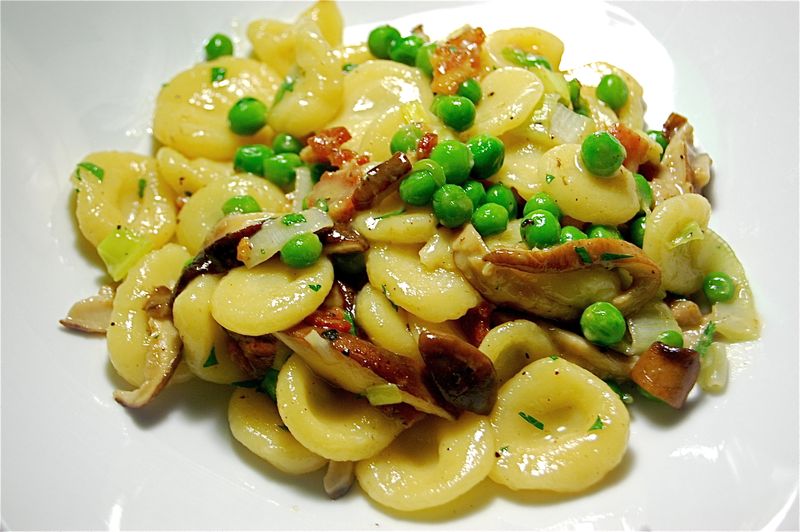

Orecchiette means “little ears” in Italian. These small, dome-shaped pasta discs are the signature pasta of Puglia in southern Italy, where they are traditionally shaped by hand from only semolina and water. The curved cup holds small pieces of vegetable and meat, and the slightly rough surface grips olive oil and cheese. This guide covers the history, ingredients, how to shape orecchiette by hand, how to cook them, and three classic sauces.
What orecchiette are
Each piece is a small concave disc: a thicker rim and a thinner, softer centre. Cooked well, that gives two textures in one bite, a firm, chewy edge and a tender middle. The dome catches chunky sauces, and the rough underside, made by dragging the dough across a board, grips oil and grated cheese.
History and origins
Orecchiette are closely associated with Puglia, and above all with Bari. The old town, Bari Vecchia, has an alley known as the Strada delle Orecchiette (Via Arco Basso), where women still shape the pasta by hand and sell it fresh outside their doorways.
The exact origins are debated. One popular theory links the pasta to the Norman-Swabian period in southern Italy (12th and 13th centuries), when a dried, hollowed pasta may have arrived from the Provence region of France. Another suggests ancient forerunners such as the Roman lixulae, flour-and-water preparations mentioned in some ancient sources, though the link is speculative. What is certain is that orecchiette became a staple of Pugliese home cooking, made without eggs from the region’s durum wheat. For more on the wider tradition, see our regional pasta guide.
Ingredients
Authentic orecchiette use only three things:
- Semola rimacinata: twice-milled durum wheat semolina. It is fine, golden and strong, which gives the dough its chew. All-purpose flour makes a softer dough that does not hold the dome shape as well. See our pasta flour guide.
- Warm water: about 38 to 43 °C (100 to 110 °F), which hydrates the semolina quickly.
- Fine sea salt: a small pinch, although some traditional cooks leave it out and rely on salted cooking water.
How to make orecchiette by hand
- Mix. Pour 400 g of semolina onto a wooden board and make a wide well. Add about 200 ml of warm water and a pinch of salt. Draw the flour into the water with a fork until a shaggy dough forms.
- Knead. Work the dough with the heel of your hand for 10 to 12 minutes, until smooth and slightly springy.
- Rest. Wrap it tightly or cover it with an upturned bowl for 30 minutes. This relaxes the gluten so the dough is easier to shape.
- Roll a rope. Cut off a small portion and roll it into a rope about 1.2 cm (½ inch) thick, keeping the rest covered.
- Cut and drag. Cut pieces about 1.2 cm long. Place a blunt dinner knife at the far side of a piece at a slight angle, press down and drag it towards you. The dough curls over the blade into a rough shell.
- Invert. Slip the curl over your thumb and turn it inside out, so you have a small dome with a rough outside and smooth pocket.
- Dry. Lay the pieces on a tray or cloth dusted with semolina without touching, and leave for at least an hour before cooking.
The method is related to the one for cavatelli and malloreddus. For tools, see homemade pasta tools.
How to cook orecchiette
- Use about 1 litre of water per 100 g of pasta, with about 10 g of salt per litre. The water should taste clearly salty.
- Add the orecchiette and stir at once.
- Fresh handmade: about 3 to 5 minutes. They rise to the surface, and then need another minute for the thick rim.
- Dried: about 11 to 14 minutes. Check the packet and taste 2 minutes early.
- Lift the pasta into the sauce with a spider strainer, so some of the starchy water comes with it, and toss over heat with a splash more. See mantecatura and pasta water.
Because the thin centre cooks faster than the rim, finishing the pasta for a minute or two in the sauce, not just in the pot, gives a more even texture. See also pasta cooking.
Three classic recipes
1. Orecchiette con le cime di rapa
The signature dish of Bari. Bitter greens (cime di rapa, similar to broccoli rabe), garlic, chilli, anchovy and olive oil.
| Ingredient | Quantity (serves 4) |
| Orecchiette | 400 g |
| Cime di rapa or broccoli rabe, trimmed | 500 g |
| Extra-virgin olive oil | 4 to 5 tablespoons |
| Garlic | 3 cloves |
| Anchovy fillets in oil | 4 to 5 |
| Chilli flakes | 1 teaspoon |
- Boil the greens in salted water for about 5 minutes to tenderise them.
- Add the orecchiette to the same pot and cook until al dente.
- Meanwhile, warm the oil in a wide pan with the garlic, chilli and anchovies, mashing the anchovies until they dissolve.
- Lift the pasta and greens into the pan with a spider, add a ladle of cooking water, and toss on high heat for about a minute until the greens break down into a creamy sauce.
- Serve without cheese, or with toasted breadcrumbs.
For a variation with sausage, see our orecchiette with broccoli rabe and sausage.
2. Orecchiette al ragù barese
A Sunday dish. A slow tomato ragù made with pork, beef and sometimes stuffed meat rolls (involtini). The cups catch the sauce. Finish with Canestrato Pugliese or Pecorino Romano.
3. Orecchiette with cherry tomatoes and cacioricotta
A light summer version. Sauté cherry tomatoes in olive oil with basil until they just burst, toss with the pasta off the heat, and finish with grated cacioricotta, a sheep and goat cheese from Puglia.
For a spicy Bari dish, see spaghetti all’assassina. For more matches see our pasta pairing guide.
Fresh, artisan dried and mass-produced
| Feature | Fresh handmade | Artisan dried (bronze die) | Mass-produced |
| Surface | Porous, rough | Matte, slightly rough | Smoother |
| Sauce grip | Very good | Very good | Often weaker |
| Cooking time | 3 to 5 minutes | 11 to 14 minutes | 8 to 10 minutes |
| Best with | Sautéed greens, light sauces | Thick vegetable ragù, pesto | Simple tomato sauces |
Bronze-die pasta has a rougher surface, and slow, low-temperature drying is often associated with better texture, but results vary by brand. See bronze-cut vs Teflon pasta.
Nutrition
Per 100 g of dry orecchiette, expect roughly 350 kcal, 70 to 72 g of carbohydrate, 12 to 13 g of protein, 3 g of fibre and 1.5 g of fat. The traditional pasta is egg-free. Check the label of any brand.
Orecchiette substitutes
If you cannot find orecchiette, look for a small, cupped or curled shape that catches greens, sausage and small pieces of sauce:
- Cavatelli: also from southern Italy, with a similar dense bite. The best swap for orecchiette with broccoli rabe.
- Small or medium conchiglie: the cup shape holds sauce in the same way.
- Campanelle: ruffled cones that trap small pieces.
- Farfalle: easy to find, though flatter, so it holds less sauce.
Cooking times differ, so follow the packet. For more swaps, see the pasta substitution chart.
Common questions
Is orecchiette vegan?
Traditional orecchiette are semolina and water, so yes. Check the label for egg.
What can I use instead of orecchiette?
Cavatelli, medium shells (conchiglie) or campanelle.
Why are my handmade orecchiette gummy?
Usually the centre is too thick, or they were not cooked long enough. Press the centre thin when shaping, and let the rims soften fully.
Can I freeze them?
Yes. Freeze on a lined tray for about 2 hours, bag them, and cook from frozen with an extra minute. They keep for up to 3 months.
Why cook the greens in the same pot?
The pasta picks up flavour from the greens, and the greens break down into a creamy sauce when they are tossed in the pan.
Do I use cheese?
Purists leave it out of cime di rapa, but pecorino or breadcrumbs are used in many homes.
Keep exploring
For other southern shapes, see trofie, pici and the full shape guide.
Related guides: compare other sturdy shapes in best pasta for chunky sauces, find swaps in the pasta substitution chart, or browse the pasta shapes A to Z.
Further reading: Wikipedia: Orecchiette

Syed Yasar Arafat is the founder of PastaLoverz.com and a food research enthusiast with a focused interest in pasta varieties, traditional Italian cuisine, and balanced eating. Through PastaLoverz.com, he publishes well-researched articles that explain pasta types, cooking methods, and nutritional considerations in clear, practical terms to help readers make informed food choices.